Reinterpreting Synthesizer Parameter Spaces
for Expressive Tone-Shaping Audio FX Design
Recent text-guided audio FX research has focused on translating natural-language descriptions into parameters or chain configurations within existing FX systems. However, comparatively little attention has been paid to how the internal control space of an individual FX processor can itself be constructed. To address this gap, we propose CTAG-FX, which functionally reinterprets the roles of 78 parameters in a text-conditioned synthesizer configuration as controls of a tone-shaping FX processor. Each synthesizer configuration defines a fixed tone-shaping processor that can be repeatedly applied to new audio inputs rather than producing only a one-off rendered output. The text-conditioned synthesizer configurations are generated using A&R-CTAG, a retrieval-enhanced extension of CTAG. We evaluate CTAG-FX through signal-level analysis, together with a scrambled-mapping ablation in which parameter-to-control assignments are randomly permuted to assess the contribution of the proposed role assignment. Role-based mapping produces prompt-distinct spectral and nonlinear behavior, whereas scrambling reduces this prompt-specific differentiation and yields a more prompt-insensitive nonlinear profile. Overall, these results suggest that synthesizer parameter spaces can serve not only as sound-generation spaces but also as design resources for constructing new audio-FX control spaces.
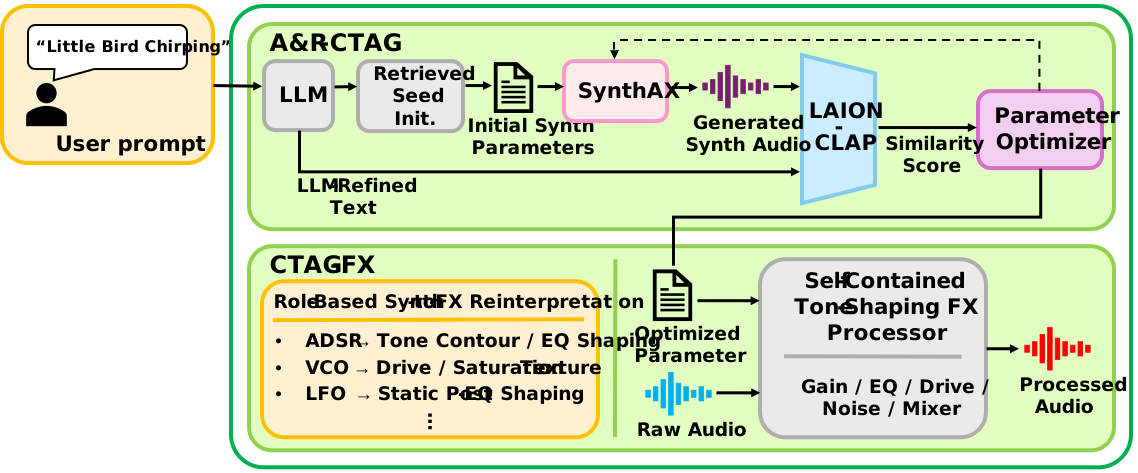
CTAG-FX workflow from text prompt to tone-shaping FX processing.
Once a CTAG-FX configuration is fixed, its input-output response can be captured with Neural Amp Modeler (NAM) and loaded into a compatible host for real-time processing. The examples below demonstrate the resulting playable guitar tones.
This test examines whether the reinterpreted synth-to-FX mapping functions as an actual tone-shaping processor. The same guitar inputs are processed with configurations generated for four tone prompts, ranging from mild clean/crunch characters to strongly nonlinear fuzz/distortion characters.
This test examines whether character cues encoded in A&R-CTAG's synth-side representations can be plausibly recast as tone-shaping FX characters for external audio. The materials support separate comparisons of reference-to-synth concept correspondence and synth-to-FX character correspondence.
Four reference sounds used in the user study are compared with the corresponding A&R-CTAG synthesized character representations.
CLAP Score: 0.7963
CLAP Score: 0.7591
CLAP Score: 0.7544
CLAP Score: 0.6556
These are additional A&R-CTAG synthesized character examples. They are included as standalone listening samples beyond the user study examples.
CLAP Score: 0.6944
CLAP Score: 0.7859
CLAP Score: 0.6129
CLAP Score: 0.7818
CLAP Score: 0.7947
CLAP Score: 0.4257
The following examples show how A&R-CTAG character representations are applied to guitar RAW input as final tone-shaping FX outputs.
Code release coming soon.
Geonung Jo
taylor3527eg@gmail.com